
Portland Previous Resident Sources
Previous residents are best traced by era and source type. The present-day address leads to a parcel and its legal description. Recorded instruments then identify people or entities connected to transactions, not automatic occupants. Earlier research moves into indexed books, archival reels, local history, and dated newspaper material. Portland is normally researched through San Patricio County in Sinton, although a very small submerged part of the city lies in Nueces County. Confirm the actual parcel geography before assuming the county for an unusual shoreline or boundary location.
| Source | Years covered | Where held | What it can show |
|---|---|---|---|
| Official Records Search | 1983 to present | San Patricio County Clerk | Recorded instrument parties, dates, document data, and legal-description leads. |
| County QuickLinks | 1848 to 1983 | San Patricio County Clerk collection | Pre-1983 real-property and Commissioners Court index books. |
| TSLAC county-record reels | Series-specific dates | Texas A&M University-Kingsville via the finding aid | Deeds, deeds of trust, probate, court minutes, surveys, marriages, and tax rolls. |
| Portland News collection | 1971 to 1988, with gaps | UNT Portal to Texas History | Dated notices, local business context, and historical name or address clues. |
| Library local history | Holdings vary | Bell/Whittington Public Library | Texana titles and Gregory-Portland High School yearbooks for most years. |
Use the source for the question it can answer. A deed can support a recorded transaction. A historical scan can support a name or address at its publication date. Both need corroboration before being treated as a past-resident conclusion.
Portland Records Since 1983
The San Patricio County Clerk Official Records Search is described as covering 1983 to the present. Its Quick Search accepts a search term that may be a grantor, grantee, subdivision, document type, or document number. Recorded-date range fields and short date presets can narrow a result. Advanced Search adds party, grantor, grantee, recorded and instrument dates, document type, document-number range, book, volume, page, lot, block, legal description, and an OCR phrase. OCR is useful for discovery, but a name, number, or legal description should be read from the instrument image before it is relied on.
The Clerk’s recorded search distinguishes its categories, including property records, assumed names, marriage, births, deaths, governmentals, Commissioners Court, marks and brands, foreclosures, and public notice. A category tab does not mean that every item has the same dates or image access. The index also does not state that a listed party lived at the Portland property. A transfer may involve a lender, trustee, company, heir, or other non-occupant.
The public Official Records Search is the current-index route described in the county research.
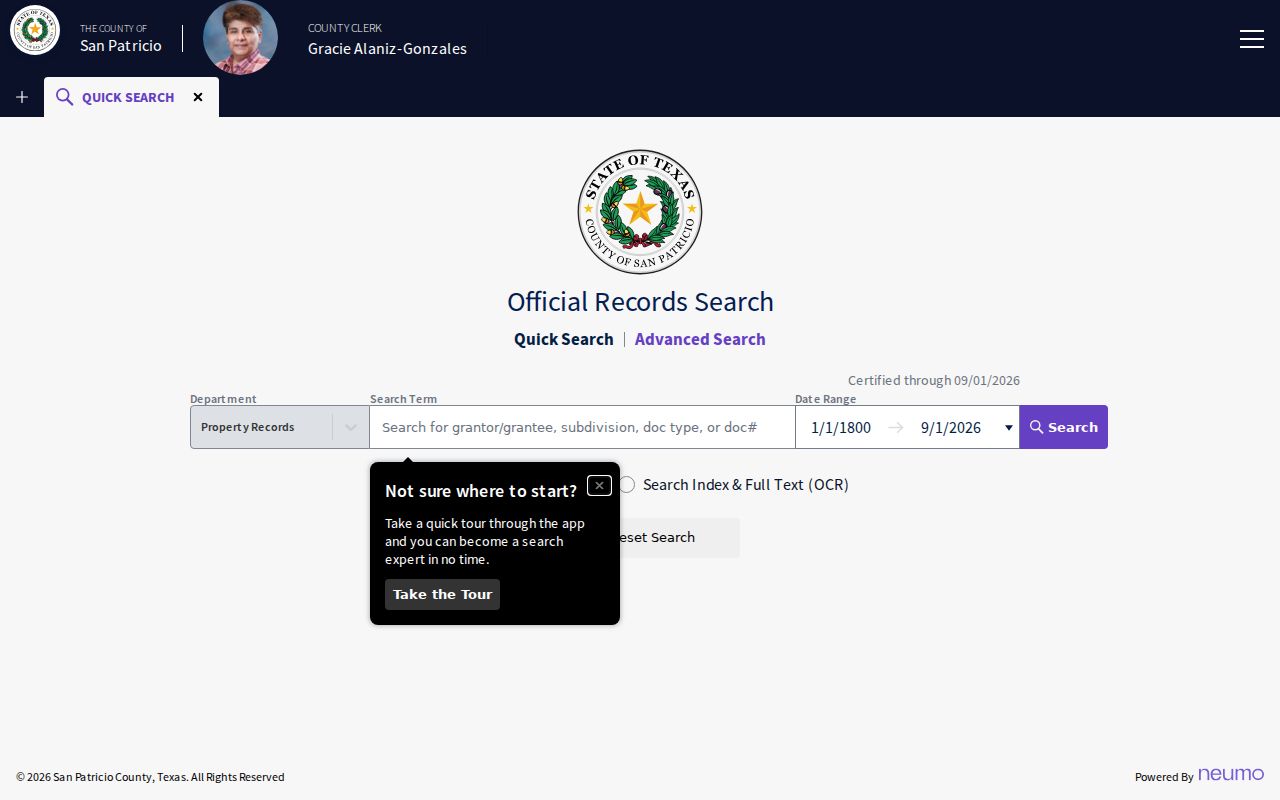
Record the instrument number or book and page, instrument date, recording date, parties, document type, and legal description. Then compare those fields with the parcel record and the prior document cited in the image. Those details make a past-resident search reproducible without overstating what the index proves.
Portland Deed Chain Steps
A chain of title follows property transfers backward. Start with the current parcel clue, then follow the recorded instrument to the earlier transfer. San Patricio CAD and direct GIS pages were not available during research, so their live field labels remain a verification gap. The county tax portal can still be searched by owner name, property address, account number, CAD reference number, or fiduciary number. Use any result as a lead, then compare it with the Clerk’s instrument image.
- Normalize the Portland address with USPS and keep the entered and standardized forms.
- Use the county tax search or a verified CAD result to locate the account or CAD reference and legal description.
- Find the latest conveyance in the Clerk index. Read the image for the recorded buyer, seller, execution and recording dates, and prior-reference language.
- Search the earlier seller as a grantee to locate that party’s prior acquisition, then repeat while the legal description remains consistent.
- When the chain reaches the online cutoff, continue in QuickLinks and the relevant TSLAC reel or volume instead of treating the cutoff as the beginning of the property.
- Grantor
- The person or entity giving an interest in an instrument, commonly the seller in a deed.
- Grantee
- The person or entity receiving an interest. A grantee can be an owner of record without being an occupant.
- Chain of title
- A sequence of recorded transfers or interests connected by a consistent legal description.
- Legal description
- The lot, block, subdivision, tract, or survey wording that identifies land more reliably than a changing street address.
Note: A deed chain is a property history, not a complete household history, so retain separate evidence for any claim about who lived at a Portland address.
Portland Records Before 1983
For a Portland address before 1983, use the San Patricio County Clerk QuickLinks collection first. County material describes real-property and Commissioners Court index books from sovereignty through March 4, 1983. The collection is the bridge from the modern Clerk index to earlier deed and county-record series. Search surname variants, initials, married or maiden names, subdivision names, lot and block, document numbers, adjacent dates, and legal-description terms. A historical street address may be absent from an old instrument.
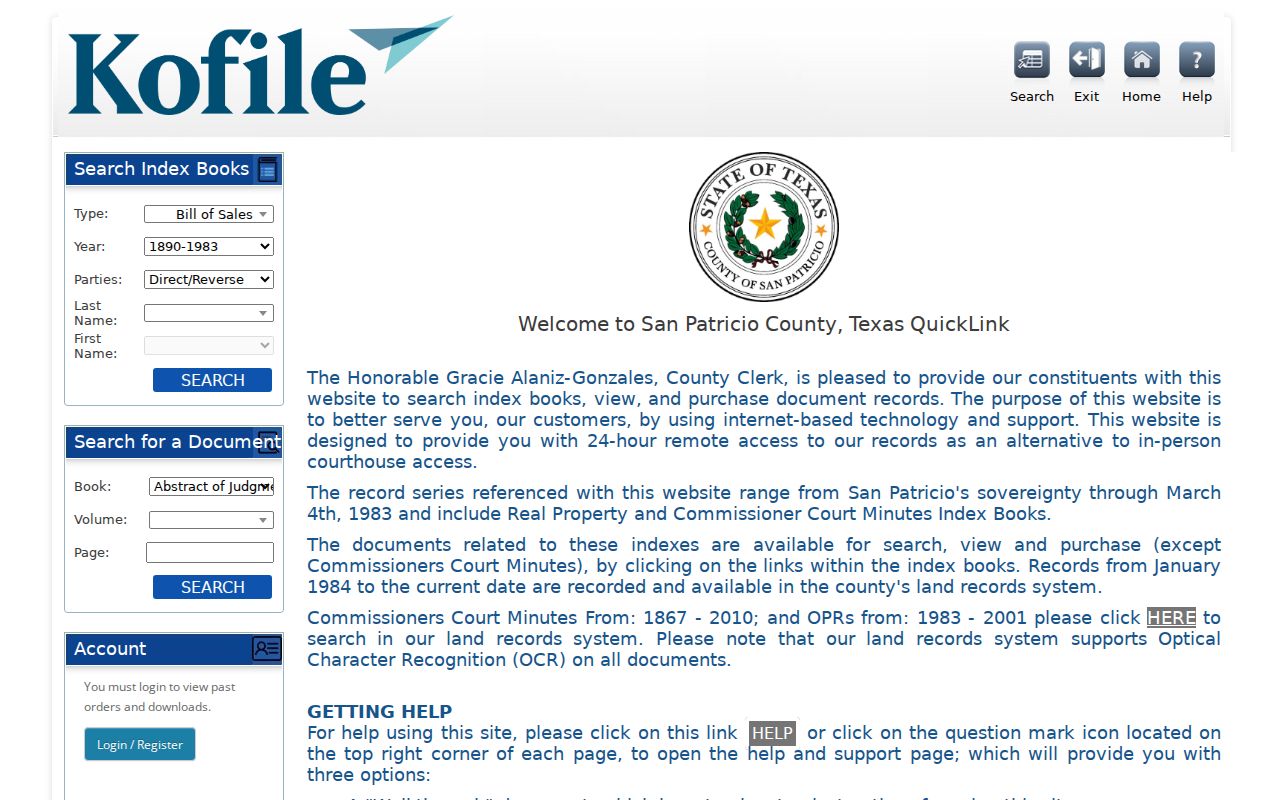
QuickLinks is an index and image-navigation path, not a title opinion. Read the underlying record where available and capture the index book, page, volume, and date. The 1891 Portland town map filing at the county courthouse is a useful historic anchor, but it does not identify all later parcels or prove later occupancy. Pair it with deeds, tax rolls, and dated local sources.
Portland Reels and Courthouse Fire
The TSLAC San Patricio County guide identifies specific historical reels rather than a single complete online archive. It lists Deed Record 1846 to 1891 and its 1848 to 1896 index on reel 1013266, deed volumes 1 through 8 on reels 1013266 through 1013270, and Deed of Trust material for 1875 to 1896 on reel 1013271. Probate minutes, court minutes, naturalization lists, survey records, marriage records, and tax rolls have their own listed reels and coverage. TSLAC says the historical microfilm is held through Texas A&M University-Kingsville, and its staff cannot perform routine remote personal-name searches.
Early gaps need extra care. San Patricio’s 1872 courthouse burned in 1889, and the county seat moved to Sinton in 1894. An absent pre-1890 entry may reflect incomplete, reconstructed, or differently filed records. It does not establish that no transaction or household connection existed. Check the QuickLinks index, the relevant TSLAC reel, and alternate party or legal-description terms before drawing a negative conclusion.
Portland Past Household Clues
Property ownership is only one layer of past-resident work. Bell/Whittington Public Library identifies a Texana and reference collection plus Gregory-Portland High School yearbooks for most years. Staff can be asked about city-directory editions, vertical files, obituary clippings, cemetery material, yearbook restrictions, and whether a surname search is available. No exact digitized Portland city-directory run was verified, so it is better to ask for a specific year than to assume a criss-cross volume exists or lists a given address.
The UNT Portland News collection, a Bell/Whittington partner collection, has date groups from 1971 through 1988 with gaps. A notice, advertisement, obituary, wedding item, school report, or civic mention is a dated clue. Preserve its issue date, page, headline, and scan URL. A business advertisement can show a business used an address on that date. It does not establish that an owner, worker, or contact person lived there.
When a historical Portland listing needs modern verification, use the Portland Directory Book route for the collection context, then return to parcel and deed records for the address trail. Keep independent dates aligned. A newspaper and a deed may refer to the same name but answer different questions.
Portland Tax Roll Evidence
TSLAC lists San Patricio tax rolls for 1846 through 1910 on reel 120501. Historical tax rolls can show tax presence, property or personal-property entries, and poll-tax material, but their arrangement and coverage have limits. The TSLAC tax-roll guide warns that rolls may be grouped by surname initial without being strictly alphabetical and may not be indexed. Search nearby initials and both resident and non-resident headings before treating a missing page as a negative result.
Tax-roll clues should be paired with a dated deed, an index entry, or another independent record. A tax name can support a place-and-time lead. It does not prove that the named person occupied a particular Portland structure, and a tax mailing address is not a residency finding.
Portland Address Transition Search
Old and current address text can both be valid search inputs. Portland’s annexation FAQ says USPS controls the city and ZIP designation and may use old and new addresses for up to 18 months after an address change. Retain the original street spelling, USPS-normalized form, old city label, and date of each source. Compare the County Clerk legal description, city annexation materials, county tax account, and city map instead of forcing every record into the current label.
No verified Portland street-renumbering chronology or ZIP realignment was found. No Portland-specific Sanborn map was verified either. For an apparent address mismatch, report that as a verification gap and pursue the dated source, map, or official custodian rather than inventing an address conversion.
Portland Filing Alert Context
The County Clerk’s Property Alert service is a forward-looking companion to historical research. It offers a free name or keyword alert, including an option to create an alert from a document, for later recorded filings. It can flag a later lien, release, or possible fraud-related filing for review. It cannot reconstruct a past chain of title, prove ownership, or replace reading a recorded image.
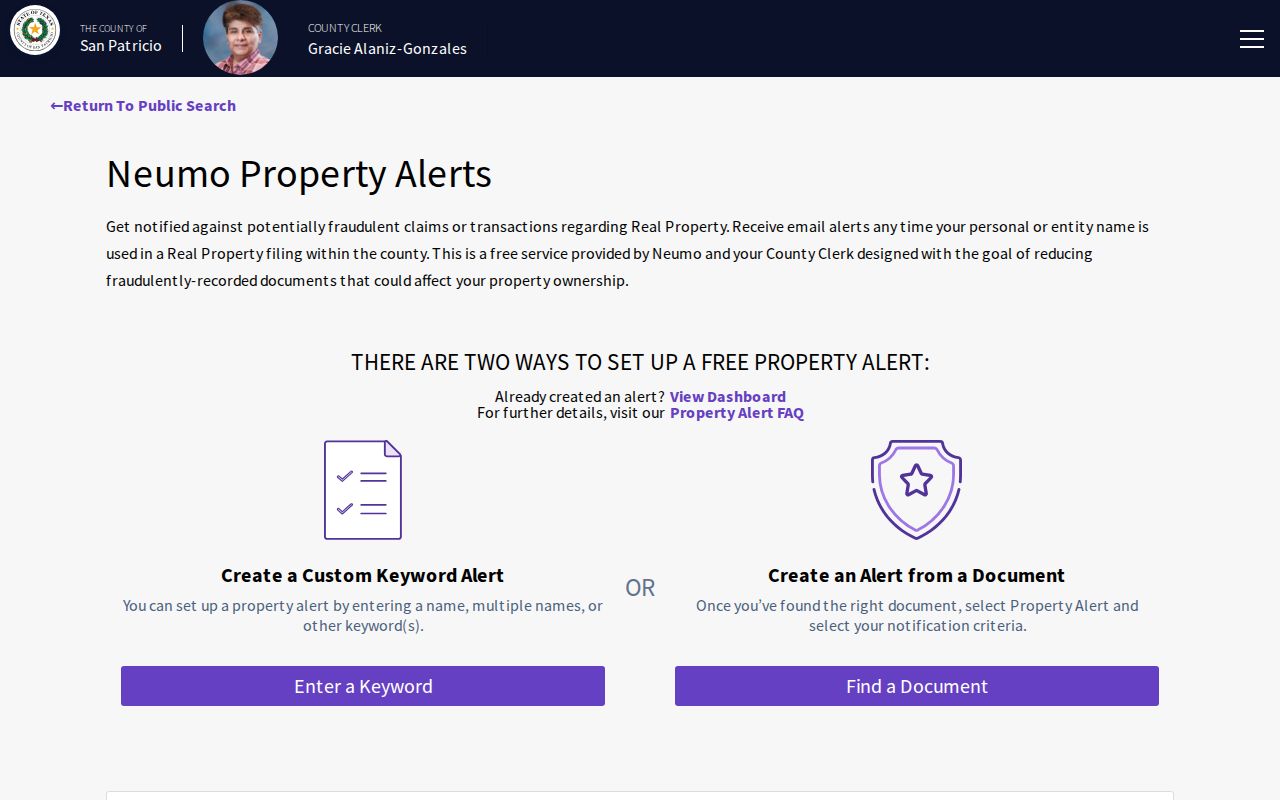
The service has a third-party-host disclaimer. Verify any alert against the official instrument and seek qualified title advice for a title conclusion. The useful Portland pattern is historical indexes and reels for the backward trail, then the alert for later filings that may need prompt review.