
Portland City Directory Sources and Shelves
Portland has no verified, continuous city-directory run in the research record. That matters. A catalog result for a Texas directory is not evidence that it contains Portland, and a local-history title is not automatically a name-and-address list. The useful Portland trail begins at Bell/Whittington Public Library, then moves outward to its partner newspaper collection, Texas State Library and Archives Commission holdings, the UT directory collection, and WorldCat. Ask for a particular year, a surname, a former street spelling, and whether the item is print, microform, or a digitized scan.
| Portland source | Reported period | Keeper or route | Realistic access |
|---|---|---|---|
| Texana and local-history reference books | Historical subject coverage, not a directory run | Bell/Whittington Public Library | Ask staff for the shelf, edition, and any related vertical file |
| Gregory-Portland High School yearbooks | Most years, according to the local-history page | Bell/Whittington Public Library | Confirm viewing and copying rules with the library |
| Portland News scans | 1971 to 1988, with gaps | UNT Portal to Texas History | Digitized issue and page browsing |
| Texas directory holdings | Year and place must be checked | TSLAC, UT, and WorldCat paths | Catalog and reading-room inquiry |
Use the table as an access map, not a claim that a Portland volume is on any named shelf. The Texas State Library and Archives Commission guide says city directories can be found in its Reference Reading Room, through digitized UNT collections, through UT's Dolph Briscoe Center, and through catalog searches. The Portland-specific gap remains open until an edition, format, and access condition are confirmed by a custodian.
Portland City Directory Leads at the Library
Bell/Whittington's local-history page identifies a Texana and reference collection along with Gregory-Portland High School yearbooks for most years. The named books are often the right first stop when an old directory line uses a place name, subdivision, or school reference that has changed. Among the listed titles are Larry W. Jacoway Sr.'s two-volume The History of Portland, Texas and Bay View College, call number 976.4115 Jacoway, Keith Guthrie's county history at 929.3764115 Guthrie, and Memories of Portland: 1776-1976 at 976.4115 Memories.
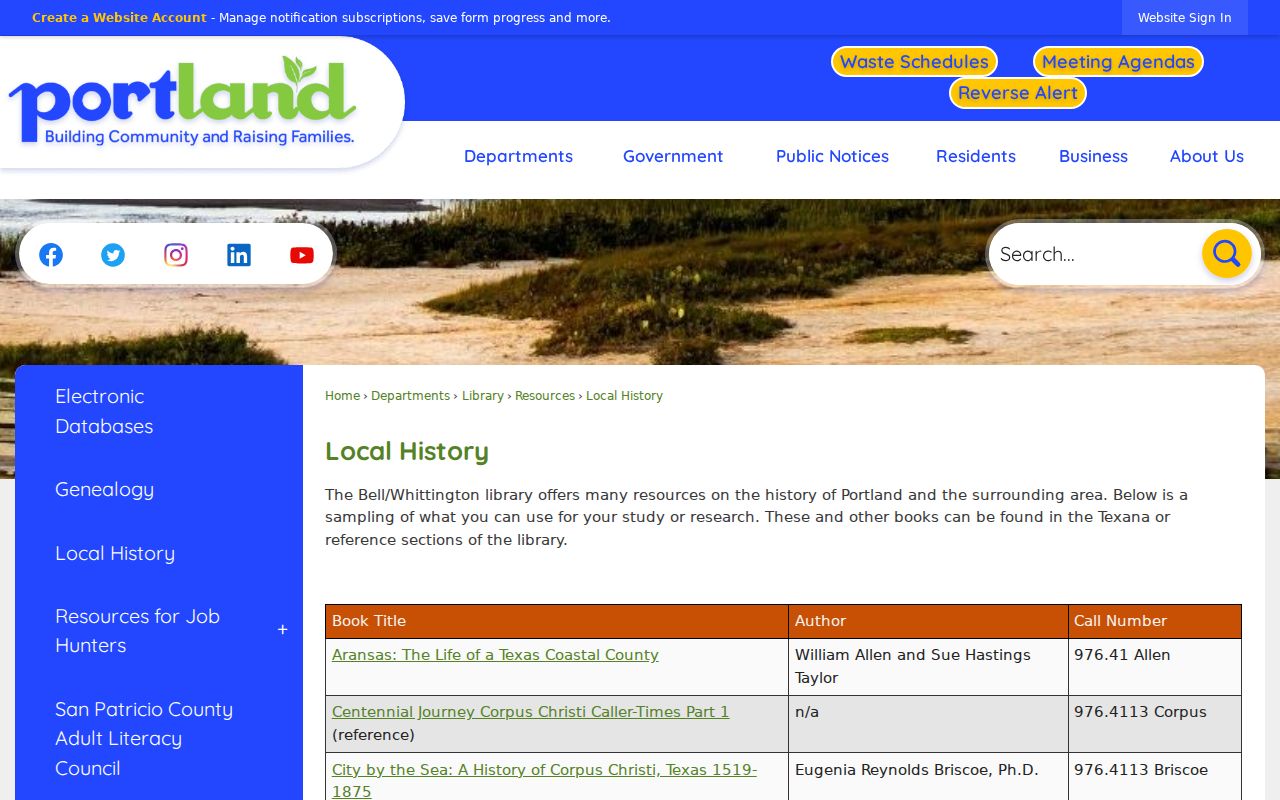
The local-history listing supports a Portland city directory search by supplying context and companion sources, not by proving a complete directory shelf. Bring the call number and publication date to the desk. Staff can then check for city directories by year, surname files, obituary clippings, cemetery material, or microfilm access that the public webpage does not enumerate.
Reference help, TexShare, electronic databases, and interlibrary loan are listed among the library resources. A request is more likely to succeed when it asks for one narrow item, such as a 1970s Portland phone book or a Gregory-Portland yearbook, rather than a broad request for every record of a person. Note: The local-history and genealogy pages leave several collection details for direct library confirmation.
Portland City Directory Access Questions
Bell/Whittington Public Library is at 2400 Memorial Parkway in Portland. Its published schedule lists Monday through Thursday from 9 to 8, Friday from 9 to 5, Saturday from 10 to 2, and Sunday closed, with a 10 a.m. opening every third Wednesday. Hours can change, so confirm before visiting. The stronger question is not simply whether the library has a directory. Ask whether it has the relevant year, whether the volume includes Portland, and whether a scan, photocopy, or on-site transcription is permitted.
The library image points to the public access route, while the actual shelf contents still need a year-by-year check. Yearbooks can add a school affiliation or spelling clue. Local histories can explain why an address or neighborhood name appears differently. Neither replaces a dated directory entry, a county record, or a newspaper scan.
For a Portland name search, prepare the full name, initials, possible married or maiden name, approximate years, and known streets. Ask the staff whether they can search a catalog or whether the material must be inspected on site. Preserve the volume title, call number, page, and issue date in notes so another researcher can repeat the search.
Portland City Directory Catalog Gap
The Portland genealogy page was reachable during research but did not return a usable page body. It is an access-gap page, not proof of a directory, obituary index, scanned yearbook, or newspaper-microfilm service. Verify its current content with library staff before relying on a catalog label or an older search result. The unanswered questions include city-directory holdings, obituary files, licensed databases, yearbook access, scanning limits, and remote-reference practice.
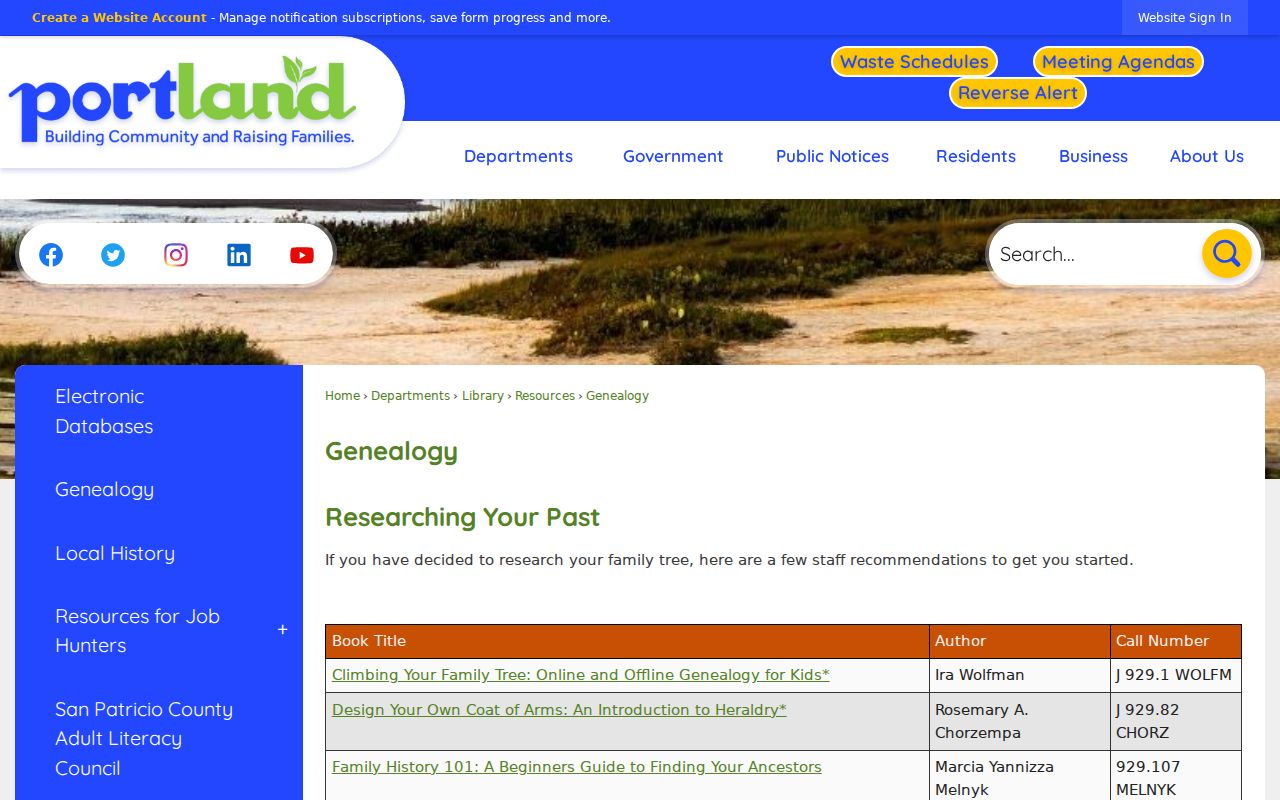
The image documents the route that needs confirmation. It does not show a usable genealogy inventory. When a sought-after name is absent from an unverified local database, move to the other documented channels: the UNT newspaper collection, TSLAC catalog paths, and county microfilm finding aids. A missing page result is not a negative family-history finding.
Catalog gaps are common in local research. Record the date of the inquiry, the exact title or year requested, and the staff response. That simple log keeps an uncertain web page from turning into an unsupported statement about Portland collections.
Portland City Directory Clues in the News
The UNT Portal to Texas History Portland News collection is a Bell/Whittington partner collection with 513 items. Metadata observed for the collection identifies 512 San Patricio County items and 512 items titled The Portland News, plus one election-news item. Its date browser shows 1971 through 1988 with gaps, so an empty result cannot establish that a person, business, or event was absent from Portland during the whole period.
Use a dated issue as a corroborating source. A March 12, 1981 Portland News page includes business-directory-style advertisements and names with addresses. Such material can show that a business used an address on that issue date. It cannot establish where a business contact lived. Capture the page number, headline or advertisement, scan URL, and issue date before comparing it to a yearbook, directory, or recorded instrument.
Obituaries, wedding notices, school activities, civic appointments, and public notices can all help distinguish two similar names. They remain date-bound historical evidence. A Portland city directory inquiry becomes more reliable when a newspaper clue is paired with a library item or an official record rather than treated as a complete household profile.
Portland City Directory History and Reels
Portland was laid out in 1890, and the Portland Harbor and Improvement Company town map was filed at the San Patricio County courthouse on June 19, 1891. That filing is a useful landmark for a historical address trail, but it is not a substitute for a later directory or deed image. County geography matters too. Sinton, not Portland, is the county seat, and the city plan notes a small submerged portion of Portland in Nueces County. Anchor a historic search to the actual address or legal description when a shoreline parcel is involved.
| 1889 | The 1872 San Patricio courthouse burned, creating a reason to check reconstructed or alternate series. |
|---|---|
| 1890 | John G. Willacy laid out Portland, according to the city history source. |
| 1891 | The town map was filed in the county courthouse record story. |
| 1894 | The county seat moved to Sinton after the courthouse era described by the Texas Historical Commission. |
TSLAC's San Patricio county guide lists reels for deeds, deed of trust, marriage, probate, court minutes, naturalization, surveys, and tax rolls. For example, its deed series begins with 1846 to 1891 material and the tax-roll series covers 1846 to 1910. The guide is a finding aid, not a remote image search. Texas A&M University-Kingsville holds the historical microfilm route, and TSLAC staff do not perform personal-name searches or routine remote copies.
Early gaps can reflect the courthouse fire, a separate index series, an alternate place name, or an unsearched reel. Do not turn a missing directory or index hit into a conclusion that a Portland family was never present.
Reading a Portland City Directory Entry
No Portland city-directory entry was inspected in the research, so its layout, abbreviations, and any reverse section must not be assumed. TSLAC describes the kinds of fields commonly found in Texas directories: name, address, telephone, spouse, occupation, and sometimes a publisher's tenure notation. Treat each field as a dated statement made by that volume. Photograph or transcribe the volume's own abbreviation key before interpreting a shortened word or a mark next to a name.
| Name | Copy initials, punctuation, and alternate spelling exactly as printed. |
|---|---|
| Address | Record the street form, number, and volume year; compare it later with address normalization. |
| Telephone | Use only as a historical source field, not a present contact detail. |
| Spouse or occupation | Use as an identity clue when the volume actually supplies it, then corroborate with an independent dated source. |
| Publisher notation | Keep the notation and page context instead of converting it into an unstated conclusion. |
- Criss-cross directory
- A directory arranged by address rather than by personal name. No Portland criss-cross volume has been verified, so confirm its existence before using the term for a local year.
- Householder index
- A name-oriented index that may identify the named household contact for a particular edition; the scope depends on the publisher.
- Abbreviation key
- The volume's own legend for shortened street, relationship, or other labels. It should be copied with the entry.
Trace Portland City Directory Households
Start with the oldest confirmed Portland appearance, not the most tempting name match. The town map, county reels, and local histories can frame an early place, while newspaper issues and yearbooks help bridge later years. Preserve both the original street wording and a modern standardized form. Portland annexation and USPS addressing can leave old and new addresses in use for as long as 18 months after a change, so one address string may miss a relevant historical item.
- Write down the exact name, street, date, source URL or call number, and page from the first confirmed item.
- Check nearby newspaper years and library yearbooks for the same spelling, initials, institution, or address.
- For a property connection, compare the legal description with the county deed index and then read the instrument image.
- Use the TSLAC directory guide, UT path, and WorldCat to ask whether a Portland or regional edition exists for the missing year.
- Label each match as a historical listing, newspaper mention, recorded party, or other source-specific observation.
A person can disappear because of a move, a name change, a missing issue, a new address form, or a collection gap. The next check should answer one narrow question. For a modern identity check after a historical hit, use the Portland resident lookup route and keep the current record separate from the older listing.
Note: A historical address line is strongest when the source date, custodian, and a second independent dated record agree.